[태그:] Carbanion

  • 탄소양이온과 탄소음이온 (Carbocation and Carbanion)

    목차

    1. Title
    2. Purpose
    3. Theory
    4. Apparatus and Reagents
    5. Procedure
    6. Cautions
    7. Data & Results
    8. Discussion
    9. Conclusion
    10. References

    본문내용

    1. Title
    Carbocation and Carbanion: n-BuLi titration and 1,1,1-Triphenylpropane
    2. Purpose
    강한 염기인 n-butyllithium을 titration하여 농도를 확인한다. 이를 triphenylmethane과 반응시켜 trityl carbanion을 생성해 1,1,1-triphenylpropane을 합성해본다.
    3. Theory
    1) Carbocation의 안정성
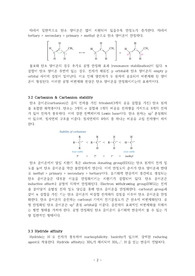
    Carbocation(탄소 양이온)은 탄소 원자가 양전하를 지니고 있는 화학종이다. 탄소 원자는 3개의 다른 원소와 결합하고, 비공유 전자쌍을 가지지 않은 채로 양전하를 띤다. 이 탄소 원자는 sp3 hybridized 되어 있고, 약 120°의 결합각을 가진다. CH3+의 경우, 정확히 120°의 결합각을 가지지만 수소가 아닌 다른 원자와 결합하는 경우 결합각이 달라지기도 한다. Carbocation의 경우, 빈 p 오비탈을 가지고 있어 강한 electrophile로 작용한다.
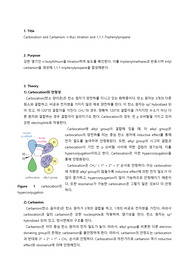
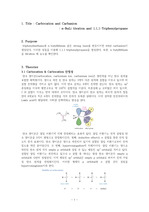
    Carbocation에 alkyl group이 결합해 있을 때, 이 alkyl group은 carbocation의 양전하를 띠는 중심 탄소 원자에 inductive effect를 통해 전자 밀도를 높여주며 안정화된다. 또한, alkyl group의 시그마 결합과 carbocation이 가진 빈 p 오비탈 사이에 약한 겹침이 생기는데, 이를 hyperconjugation이라고 한다. Carbocation은 이런 hyperconjugation을 통해 안정화된다.
    Carbocation은 CH3+ < 1° < 2° < 3° 순서로 안정하다. 이는 carbocation에 치환된 alkyl group이 많을수록 inductive effect에 의한 전자 밀도가 더 많이 증가하고, hyperconjugation이 많이 가능하므로 안정해지기 때문이다. 또한 resonance가 가능한 carbocation은 그렇지 않은 것보다 더 안정하다.
    출처 : 해피캠퍼스
  • A+ 유기화학실험1 < Carbocation and Carbanion > 레포트

    목차

    1. Title

    2. Purpose

    3. Theory
    3.1 Carbocation & Carbocation 안정성
    3.2 Carbanion & Carbanion stability
    3.3 Hydride affinity
    3.4 SN2 reaction
    3.5 SN1 reaction
    3.6 Lithiation reaction and pKa
    3.7 Handling of pyrophoric compound

    4. Reagents & Apparatus
    4.1 Reagents
    4.2 Physical properties of chemical reagents
    4.3 Apparatus
    4.4 Apparatus set-up

    5. Procedure

    6. 실험 시 주의해야 할 사항

    7. Data & Results
    7.1 Titration of n-BuLi
    7.2 Preparation of 1,1,1-triphenylpropane

    8. Discussion
    8.1 Titration of n-BuLi
    8.2 1,1,1-triphenylpropane 합성 반응 분석
    8.3 1,1,1-triphenylpropane 합성 실험 과정 분석
    8.4 TLC 결과 분석
    8.5 1H-NMR 분석
    8.6 Yield 감소 원인 분석 및 개선 방안 논의

    9. Conclusion

    10. References

    본문내용

    9. Conclusion
    이번 실험에서는 n-BuLi in hexane 용액의 농도를 titration을 통해 구하였다. 2,2’-bipyridyl이 indicator와 같은 역할을 수행하여 menthol과 n-BuLi의 반응이 끝나는 지점에서 갈색으로의 색변화를 일으켰다. 적정 결과를 토대로 n-BuLi in hexane 용액의 농도를 계산하였더니, 1.33M이었다. 이를 토대로 1,1,1-triphenylpropane 합성 반응에 필요한 n-BuLi의 농도를 계산하였다. flame drying, nitrogen charging을 거쳐 수분이 제거된 flask에서 triphenylmethane, n-BuLi, ethyl iodide를 반응시켜 1,1,1-triphenylpropane을 합성했다. TLC, 1H-NMR 분석 결과, 원하는 물질이 잘 합성되었음을 확인하였다. 그러나, SM과 다른 impurities가 존재했다. 이는 실험 중 n-BuLi를 dropwise가 아닌 one-portion으로 첨가하였기 때문에 발생하였다고 분석하였다.

    출처 : 해피캠퍼스