Blog

  • [유기화학실험2 A+]Prelab4_Acetanilide to p-Nitroaniline

    목차

    1. Objectives
    2. Principles & Methods
    3. Table of relevant chemical properties

    본문내용

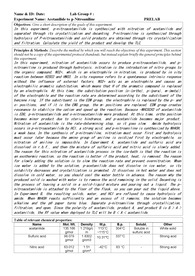
    Objectives: Give a short description of the goals of this experiment.
    In this experiment, p-nitroacetanilide is synthesized with nitration of acetanilide and separated through its crystallization and decanting. P-nitroaniline is synthesized through hydrolysis of P-nitroacetanilide and solid products are obtained through its crystallization and filtration. Calculate the yield of the product and develop the TLC.

    출처 : 해피캠퍼스

  • [유기화학실험2 A+]Labreport3_Diels-Alder reaction(1,3-butadiene+maleic anhydride)

    목차

    1. Results
    2. Discussion

    본문내용

    The yield of 4-cyclohexene-cis-1,2-dicarboxylic anhydride was as low as 53.047%. The reason for the low yield is that the crystal was less made, prematurely crystallization occurred in the slightly cooled filter paper and glass funnel, and the crystal was lost in the filtration. Crystal could have been made more if the r.b.f. had been put in the ice-bath for longer. Since the filter paper and glass funnel were taken out of the oven and the filtration was started after 1-2 minutes, crystals were made on a slightly cooled surface of them.

    출처 : 해피캠퍼스

  • [유기화학실험2 A+]Prelab3_Diels-Alder reaction(1,3-butadiene+maleic anhydride)

    목차

    1. Objectives
    2. Principles & Methods
    3. Table of relevant chemical properties

    본문내용

    Objectives: Give a short description of the goals of this experiment.
    By heating 3-sulfolene, 1,3-butadiene is synthesized, and 4-cyclohexene-cis-1,2-dicarboxylic anhydride is synthesized by Diels-alder reaction between 1,3-butadiene and maleic anhydride. Product crystals are obtained through Hot Gravity filtration and crystallization, the yield is calculated, m.p. is measured, and Rf values are compared through TLC.

    출처 : 해피캠퍼스

  • [유기화학실험2 A+]Labreport2_bromination of stilbene

    목차

    1. Results
    2. Discussion

    본문내용

    Results: Summarize the experimental results obtained.
    In the synthesis of the meso-1,2-dibromo-1,2-diphenylethane, The amount of the product is 37.0013g(product)- 36.1277g(filter paper and watch glass)=0.8736g. The number of moles of (E)-stilbene used in the reaction is 0.5g/180.250g/mol=2.774×10^3mol, and (E)-stilbene and meso-1,2-dibromo-1,2-diphenylethane react at a molar ratio of 1:1, so the number of moles of the theoretical yield of the product is also 2.774×10^-3mol.

    출처 : 해피캠퍼스

  • [유기화학실험2 A+]Prelab2_bromonation of stilbene

    목차

    1. Objectives
    2. Principles & Methods
    3. Table of relevant chemical properties

    본문내용

    Objectives: Give a short description of the goals of this experiment.
    meso-1,2-dibromo-1,2-diphenylethane is synthesized through bromination of (E) -Stilbene and separated through crystallization, vacuum filtration, and oven. For meso-1,2-dibromo-1,2-diphenylethane, the E2 reaction in which potassium hydroxide acts as a base is performed twice to synthesize diphenylacetylene.

    출처 : 해피캠퍼스

  • [유기화학실험2 A+]Labreport1_Carbocation rearrangements-benzopinacolone

    목차

    1. Results
    2. Discussion

    본문내용

    Results: Summarize the experimental results obtained.
    The amount of benzopinacolone produced is 36.5242g(product)-36.1535g(filter paper and watch glass)=0.3707g. The number of moles of benzopinacol used in the reaction is 0.5g/3.66g/mol=1.365×10^-3mol, and benzopinacol and benzopinacolone react at a molar ratio of 1:1, so the number of moles of the theoretical yield of benzopinacolone is also 1.365×10^-3mol.

    출처 : 해피캠퍼스

  • [유기화학실험2 A+]Prelab1_Carbocation rearrangements-benzopinacolone

    목차

    1. Objectives
    2. Principles & Methods
    3. Table of relevant chemical properties

    본문내용

    Objectives: Give a short description of the goals of this experiment.

    In this experiment, benzopinacol is transformed into benzopinacolone through carbocation rearrangement. Benzopinacolone is separated by suction filtration. Calculate its yield and measure its mp to determine whether it is benzopinacolone.

    출처 : 해피캠퍼스

  • 만 3세 1,2학기 관찰일지 모음

    목차

    1. 만 3세 관찰일지/1번 유아.hwp
    2. 만 3세 관찰일지/2번 유아.hwp
    3. 만 3세 관찰일지/3번 유아.hwp
    4. 만 3세 관찰일지/4번 유아.hwp
    5. 만 3세 관찰일지/5번 유아.hwp
    6. 만 3세 관찰일지/6번 유아.hwp
    7. 만 3세 관찰일지/7번 유아.hwp
    8. 만 3세 관찰일지/8번 유아.hwp
    9. 만 3세 관찰일지/9번 유아.hwp
    10. 만 3세 관찰일지/10번 유아.hwp

    본문내용

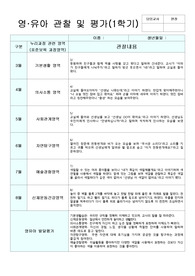
    영·유아 관찰 및 평가(1학기)

    3월 기본생활 영역
    간식 시간 전 손을 닦으러 화장실을 갔다가 다시 선생님께 와서는 소매를 걷어 올려 달라고 도움을 청했다. 걷어 올리는 방법을 설명해 주었더니 반대쪽 손을 스스로 해 보겠다고 이야기 하였다. 속에 있는 내복 양쪽 소매를 다 올린 후 다시 손을 닦으러 가서 비누를 사용하여 손을 씻고 수건에 물기를 닦아냈다.

    4월 의사소통 영역
    봄에 겨울잠을 자고 일어난 여러 동물들 중 개구리와 뱀에 흥미를 가지고 있는 모습을 보여주며 “개구리랑 뱀은 땅 속에서 잠을 자고 나와요?”라고 질문을 하였다. 평소에 좋아하는 메뚜기와 사마귀 등의 곤충에 대해서 선생님에게 이야기 해주었다.

    5월 사회관계영역
    선생님이 졸려하는 친구의 이불을 깔아주는 것을 보고는 이불 까는 것을 도와주었다.

    출처 : 해피캠퍼스

  • 상담자로서의 자기 분석

    목차

    1. 이고그램척도
    1) 아버지 자아(CP)
    2) 어머니 자아(NP)
    3) 성인자아(A)
    4) 분방한 어린이자아(FC)
    5) 순응적 어린이자아(AC)

    2. 인생태도척도

    3. 자동적 사고

    4. 출처

    본문내용

    1. 이고그램척도

    부모자아는 5세 이전에 부모를 포함한 중요 인물의 말이나 행동을 보고 무비판적으로 받아들여 내면화한 부분이다. 어머니자아(양육적 자아)와 아버지자아(비판적 자아)로 구분된다.

    (1) 아버지자아(비판적 자아)
    아버지자아(CP)는 부모나 중요인물의 윤리, 도덕, 가치관을 내면화한 성격 부분이다. 양심적, 도덕적, 규범적, 관습적인 행동으로 표현된다.

    나는 상대방을 그 자체로 존중한다. 나의 영역과 상대방의 영역이 구별되어 있음을 명확히 한다. 상대방의 영역에 침범하지 않도록, 기분 나빠하지 않도록 적절한 거리 유지를 하는것 같다. “나는 A가 더 중요하다고 생각하는데, 너는 B가 더 중요하다고 생각하는구나.”라고 말하고 더 이상 언급하지 않는다. 실례로, 3학년 겨울방학때 간호학과 동기와 있었던 일이 있다. 나는 4학년 1학기에 자기소개서 작성할 시간이 부족할 것 같으니 토익시험 준비는 1월까지 하고 2월에는 자기소개서 작성하는 데에 시간을 할애해야겠다고 동기에게 말했다. 그러자 동기는 자기소개서는 원서접수 직전까지 작성할 수 있지만 토익은 시험을 본 뒤 열흘 뒤에 결과발표가 있기 때문에 개강하기 직전인 2월 말까지 최대한 시험을 많이 보는 것이 중요하다고 말한 적이 있다. 토익도 중요하지만 자기소개서를 촉박하게 쓰면 놓치는 부분이 있을거라고 생각했지만 동기에게 내 의견을 강요하진 않았다. 다른 예로는, 고등학교 친구와 있었던 일이 있다. 친구는 문제를 많이 풀면서, 빈출되는 문제를 파악한 뒤 그 부분의 핵심 개념을 꼼꼼히 읽는 방식으로 시험을 준비하였다. 하지만 나는 처음부터 이론(개념)을 읽고 전체적인 흐름을 파악한 뒤 제대로 이해한 게 맞는지 확인하기 위한 수단으로 문제집을 활용하였다. 시험을 준비하는 방법은 다양하기 때문에 옳고 그름이 없는 문제에는 나의 생각과 상대방의 생각이 다름을 인정하고 비난이나 질책을 하지 않고 넘어간다.

    출처 : 해피캠퍼스
  • 상담사례적용 보고

    목차

    1. 수업 시간에 배운 상담 이론 중 자신이 적용하려는 이론을 선택하여 그 이유를 쓴다.
    2. 주변 사람 중 내담자를 한 명 선택한다.
    3. 내담자의 사례를 상담이론에 적용하여 상담을 한다. 상담의 목적, 활용한 상담 방법, 상담 내용 요약
    4. 상담의 결과를 정리한다.
    5. 상담에 대한 소감을 작성한다.

    본문내용

    1. 수업 시간에 배운 상담 이론 중 자신이 적용하려는 이론을 선택하여 그 이유를 쓴다.
    「인지적 상담」
    평소에 모든 일은 생각하기에 달려있다고 생각한다. 긍정적으로 생각하면 일이 잘 풀리고, 부정적으로 생각하면 끝없이 불가능해 보인다. 그래서 상담 이론 중 인간의 행동과 정서는 개인의 신념체계와 사고에 따라 결정된다는 “인지적 상담”이 가장 현실적으로 와닿았다.
    또한 아직 배우는 단계인 내가 내담자에게 상담 효과를 줄 수 있는 방법으로 적용하고 싶었다. 내담자에게 자동적 사고를 점검하는 방법을 학습시켜 단기간에 적용이 가능한 “인지적 상담”을 선택하였다. 비용이 들지 않으며 시간이 오래 걸리지 않는 방법을 찾았다. 내담자의 말을 경청하고 그 속에 문제점을 발견하고 알려주어 내담자 스스로 치료할 수 있다는 점이 매력적이었다.

    출처 : 해피캠퍼스